
2 hr
Milan Cathedral Rooftop & Interior Guided Experience
- Expert local guide
- Small group
- Skip-the-line access
- Free cancellation
Duomo Milan — Guided Cathedral & Rooftop Access
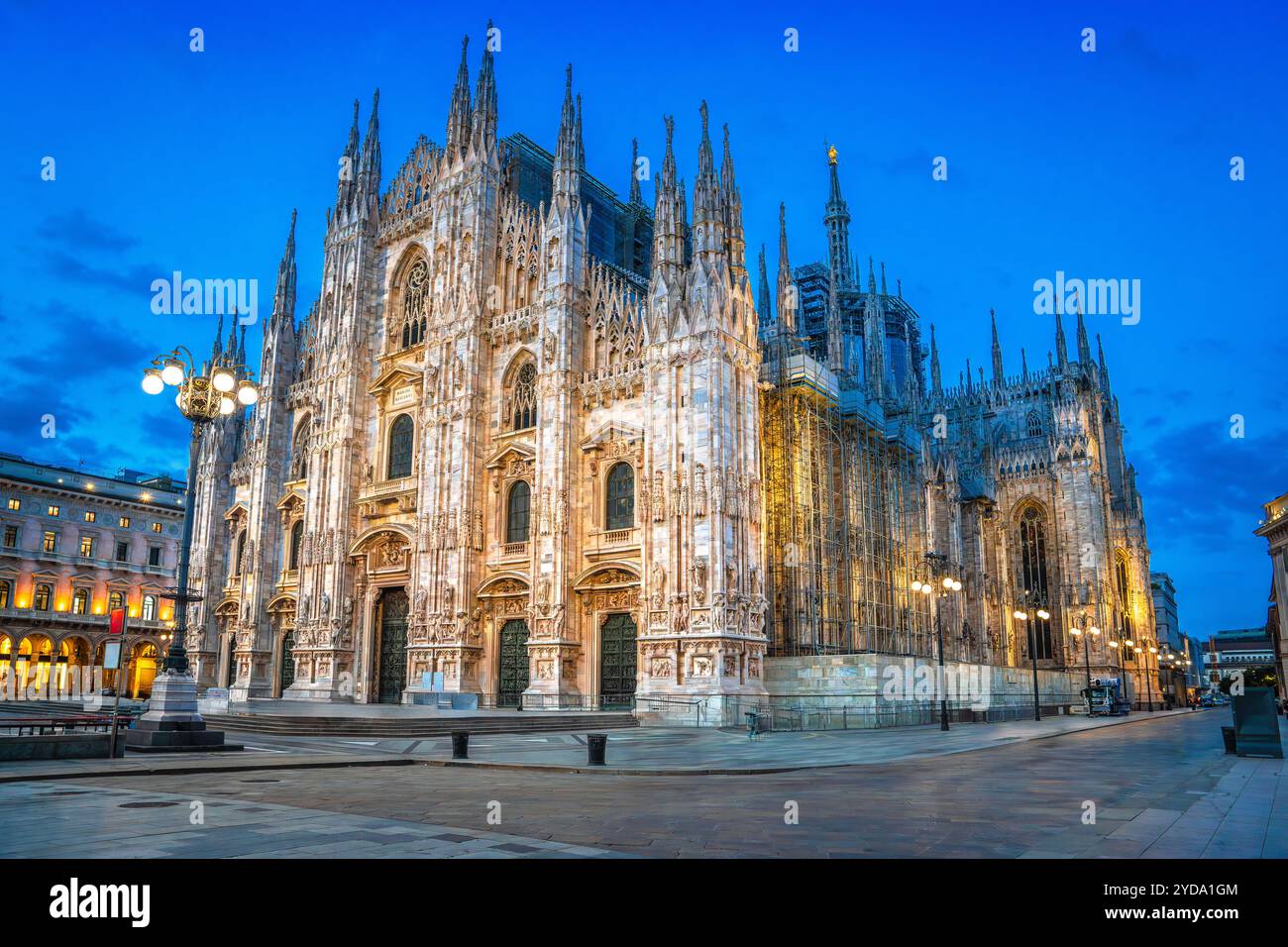
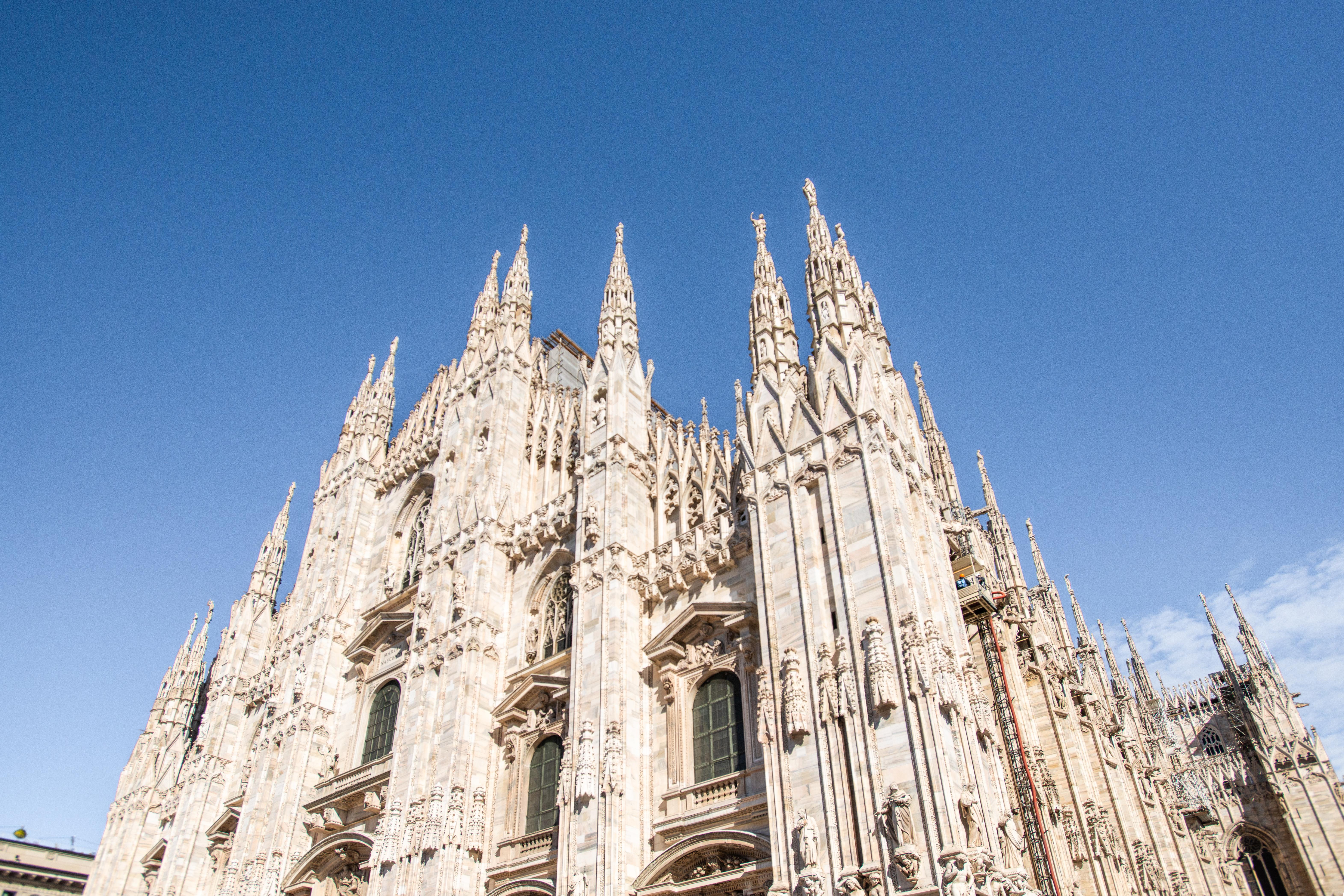
Marble spires above the piazza, quiet nave below.
Compare fares, pick the fit — all bookings are mobile-voucher and eligible for free cancellation where shown.
2 hr
2 hr
2 hr
Picking a duomo milan guided tour ticket comes down to one question: do you want the rooftop terraces, and if so, by stairs or lift? This official milano cathedral tour matrix lines up cathedral-only entry against the two terrace-inclusive combos so you can match the ticket to your mobility and schedule.
| Duomo + Museum (Cathedral only) |
Top pick Combo Stairs (Terraces by stairs) |
Combo Lift (Terraces by lift) | |
|---|---|---|---|
| Areas included | Cathedral interior, Duomo Museum, San Gottardo church | Cathedral, terraces, museum, San Gottardo church | Cathedral, terraces, museum, San Gottardo church |
| Terrace access method | — (no terrace access) | 251 steps on foot | Elevator, some steps remain |
| Physical demand | Low, level cathedral floor only | High, full 251-step climb | Low to moderate, short stair segments |
| Typical duration | 45–60 minutes | 2–2.5 hours | 1.5–2 hours |
| Best for | Budget visitors, limited time | Fit visitors wanting full access | Reduced mobility, families, timed slots |
| See tickets & prices |
Verdict: Choose Duomo + Museum at 10 EUR if terraces aren't a priority, Combo Stairs if you're fit and want the full skip-the-line duomo milan guided tour tickets experience, and Combo Lift if stairs are a concern.
Worth it for interior and museum seekers
A duomo milan guided tour built around the 10 EUR single ticket pays off if you want inside the cathedral, not just the piazza. That fee covers the Gothic interior plus the Duomo Museum, and stacked against the free exterior viewing of Piazza del Duomo, the math favors paying only when the marble columns, stained glass, and museum sculptures matter to you. The exterior facade is genuinely free and photogenic, so a purely budget-conscious visitor can skip the milano cathedral tour and still see this Milan landmark. Where a duomo milan guided tour tour earns its keep is context: guides decode the spire iconography and construction lore that plain duomo milan guided tour tickets leave silent. Families on a tight budget can admire the Lombard-Gothic exterior for nothing. Art-focused travelers and first-timers get honest value from the paid interior. Compare skip-the-line access against a self-guided ten-euro entry before booking.
Bottom line: Pay the ten euros for a milano cathedral guided experience if the interior draws you; otherwise the free piazza facade holds its own.
Hand-picked experiences loved by thousands of travelers
1.5 - 2 hours
Free Cancellation
Experience Milan's iconic cathedral with priority access, then ascend to the rooftop for breathtaking city views
1 - 1.5 hours
Free Cancellation
Bypass the crowds to explore Milan's majestic cathedral and admire panoramic skyline views from the rooftop.
3 hours
Free Cancellation
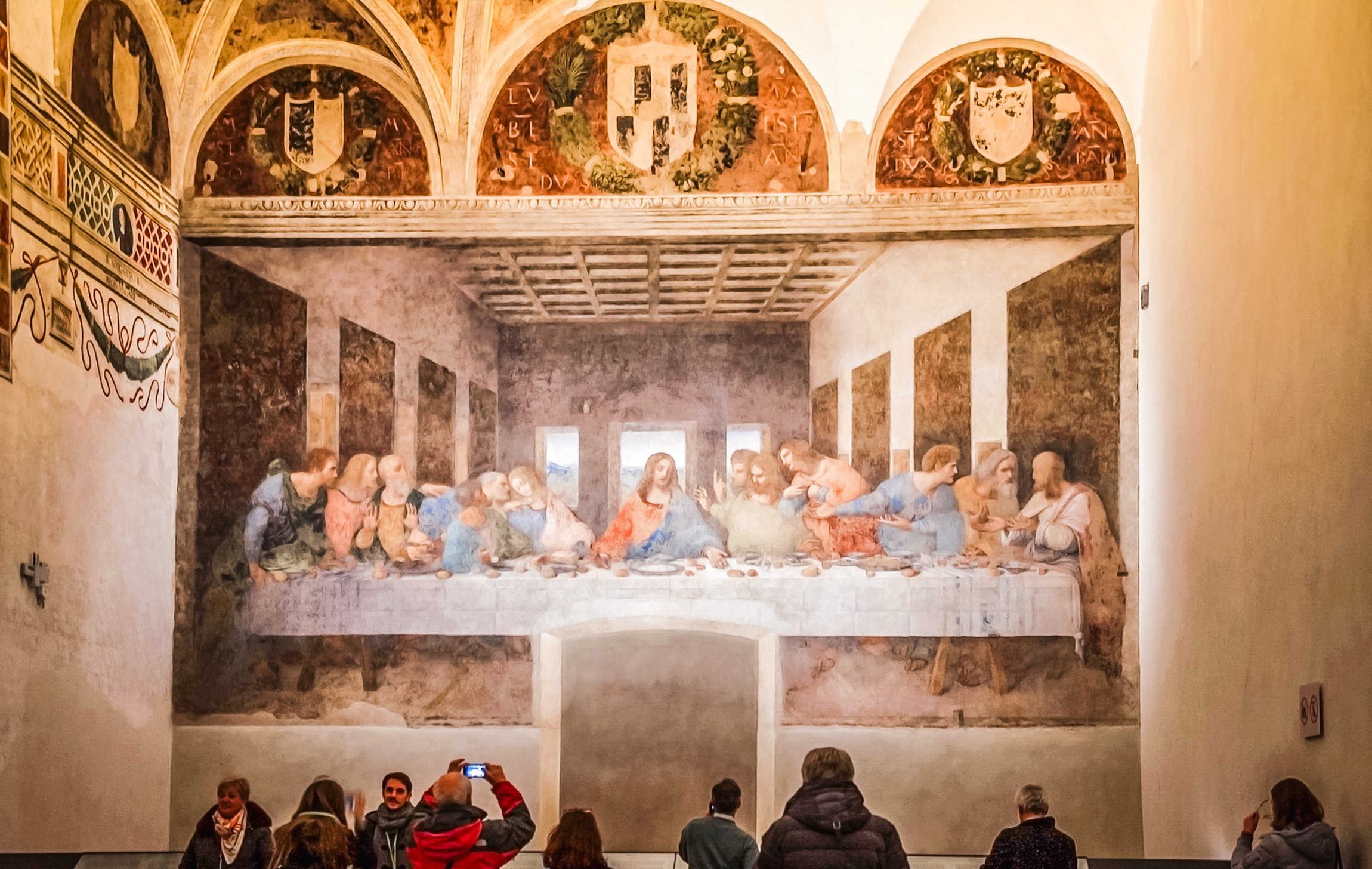
Explore Milan's historic heart and enjoy skip-the-line entry to view Da Vinci's 'The Last Supper' with a guide.
2 hours
Free Cancellation
Explore Milan's legendary cathedral with expert-led commentary, then ascend by elevator to the rooftop terraces for sweeping city panoramas.
2 hours
Free Cancellation
Explore Milan's iconic cathedral with a personal guide, then ascend to the terraces for stunning city views
Pass through bag screening and dress-code check at the Piazza del Duomo entrance.
Walk the five naves past 52 pillars, the stained glass windows, and the tomb of Gian Giacomo Medici.
Descend beneath the forecourt to see remains of earlier churches and a baptistery.
Climb the 251 steps or take the south elevator to walk among the marble spires and see the Madonnina up close.
Explore original sculptures, stained glass, and models tracing the cathedral's construction history.
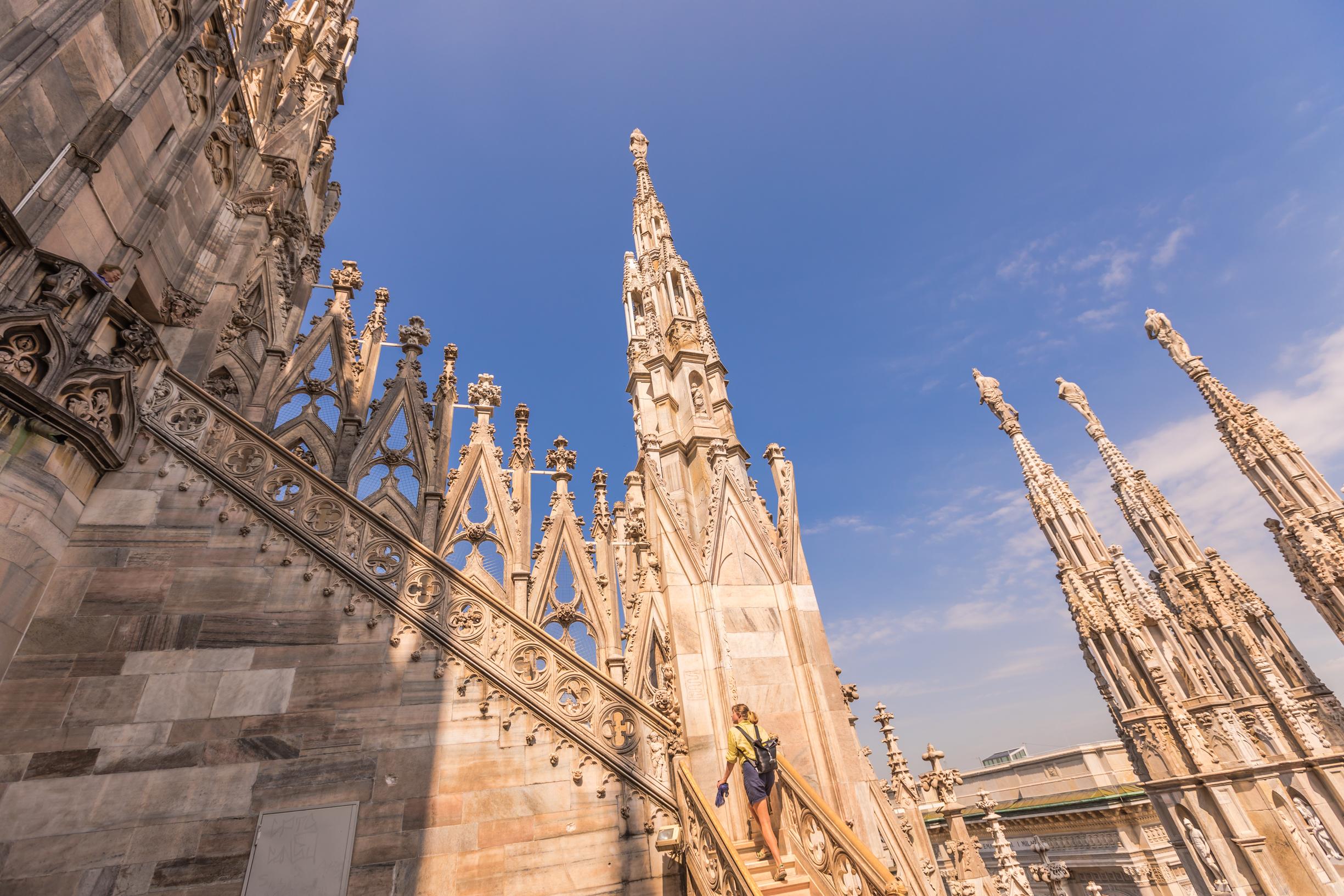
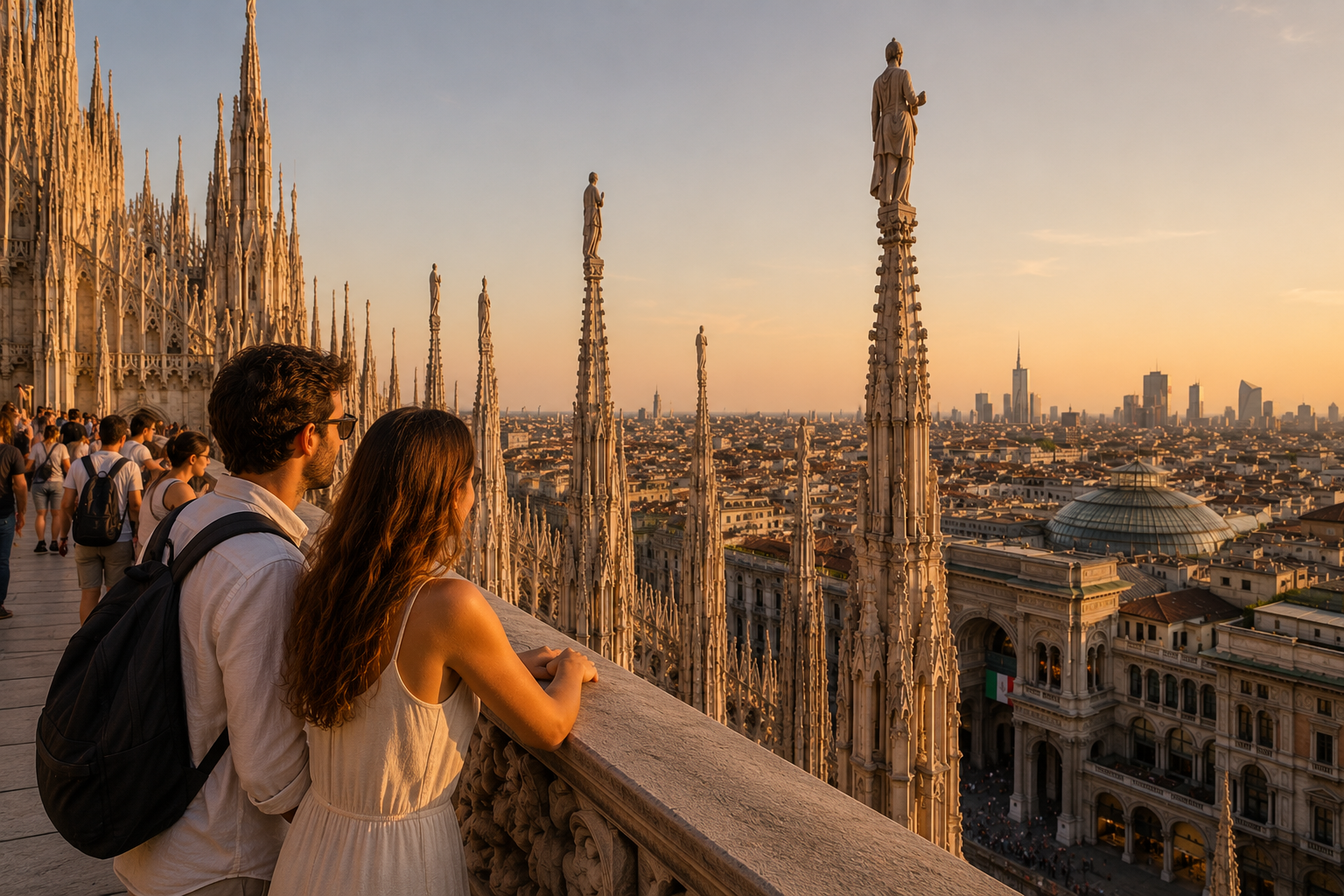
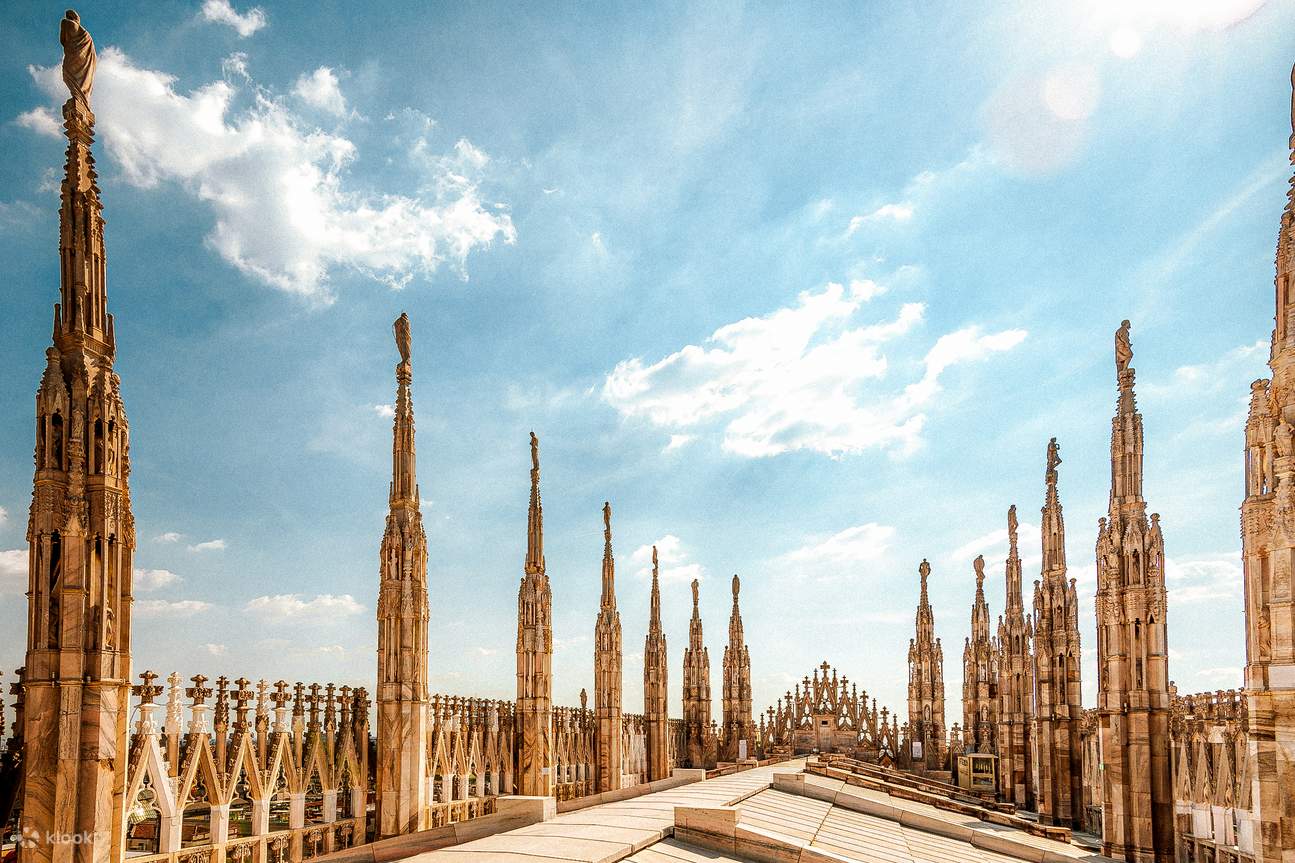
Reached by 251 steps or a partial elevator, the terraces let visitors walk among 135 marble spires at close range, roughly 70 meters above the piazza. On clear days the Alps are visible on the horizon beyond Milan's rooftops.
This gilded copper statue of the Virgin Mary crowns the cathedral's main spire at 108.5 meters above ground, standing 4.16 meters tall since 1774. An unwritten Milanese rule long held that no building in the city could rise higher than her.
Five naves run the length of the interior, supported by 52 monumental pillars, each said to symbolize a week of the year. The layout draws the eye toward the apse and its three altars designed by Pellegrino Pellegrini.
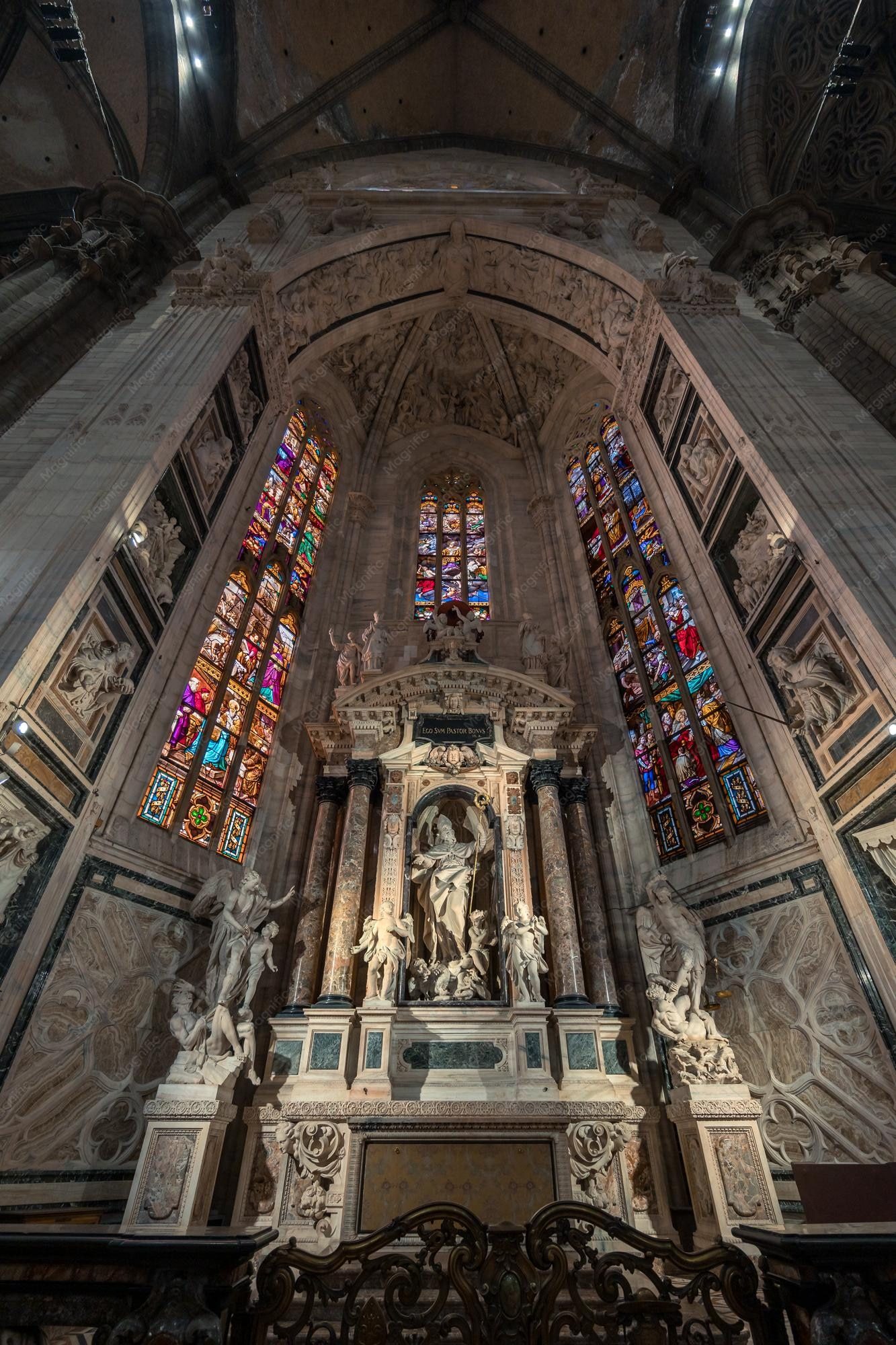
Three monumental stained-glass windows behind the altar depict Old and New Testament scenes and rank among the largest in Europe. Morning and evening light bathes the marble interior in color as it passes through the glass.
This 16th-century funerary monument in the right transept was long misattributed to Michelangelo before scholars credited sculptor Leone Leoni, who completed it between 1560 and 1563. It commemorates the brother of Pope Pius IV.
Beneath the cathedral forecourt lie excavated remains of an early baptistery and two earlier churches dating to Roman-era Milan. The site reveals layers of the city's religious history predating the current Gothic structure by centuries.
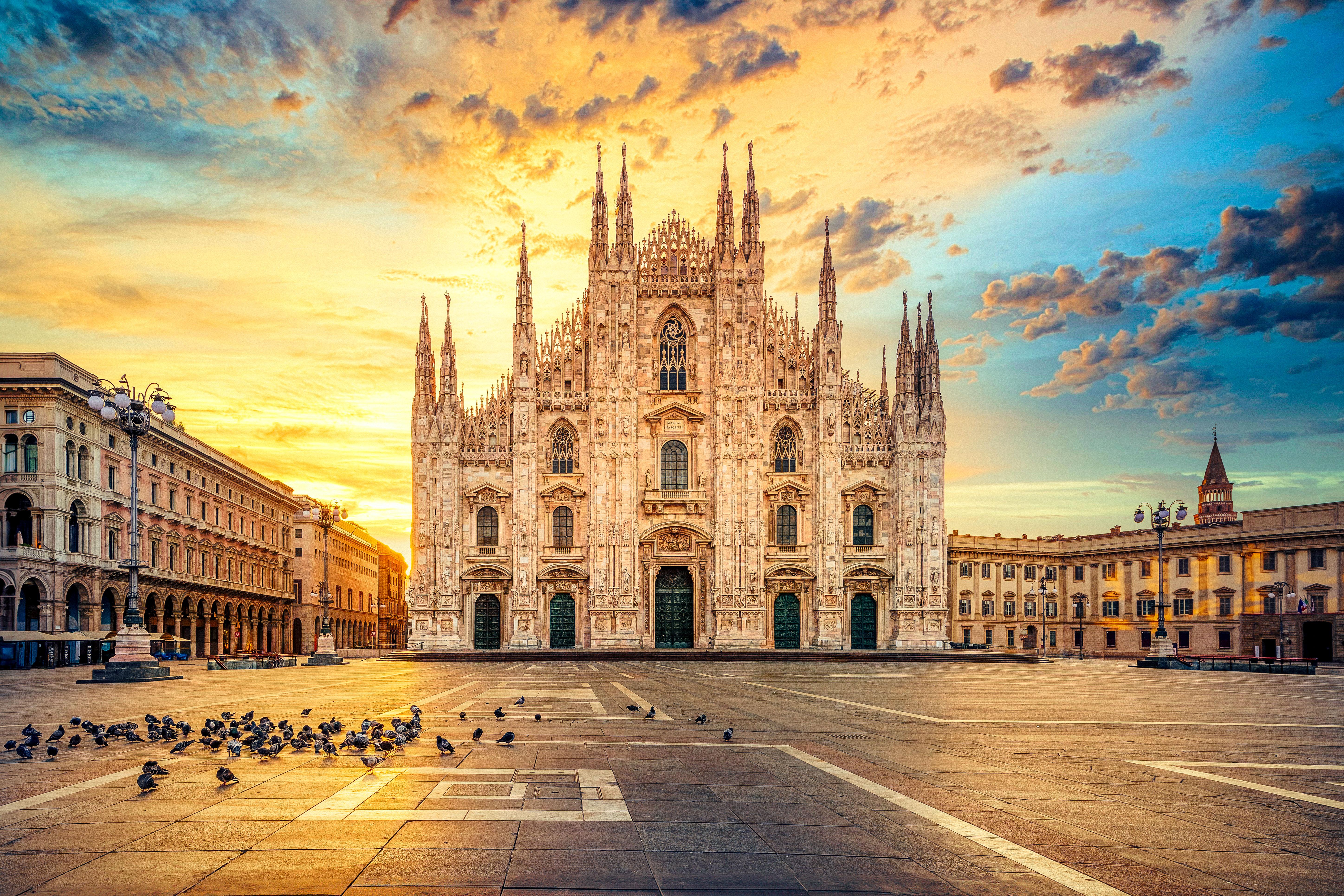
You reach Piazza del Duomo and the façade fills the whole eastern edge of the square, taller and paler than photographs suggest. You enter through the main portal into the nave, where forty pillars rise into shadow and the temperature drops several degrees; you slow down, because the stained glass pulls your eye upward before you have decided to look. You move through the interior first — the crypt, the treasury, the sunken archaeological remains of Santa Tecla beneath the modern floor. A guide points out what you would otherwise walk past. Then you climb. The 251 steps to the terraces turn tight and steady, and you feel them in your legs before the marble opens out around you. On the roof you walk between the spires. You pass close enough to touch the carved pinnacles, you find the Madonnina glinting overhead, and on a clear morning you catch the Alps on the northern horizon. A well-timed duomo milan guided tour keeps you moving while the rooftop is still quiet. You come back down into the piazza changed in scale — having stood among the buttresses, the building reads differently from below. You step back out into Milan with the cathedral now a place you have been inside and above, not only walked past.
All the details about your upcoming adventure in one place
A duomo milan guided tour brings you inside the pink Candoglia marble cathedral, past its stained-glass windows and toward the rooftop terraces crowned by the golden Madonnina. Led by knowledgeable local guides, these duomo milan guided tour tours cover the Gothic spires, the vast nave, and the panoramic terraces above Piazza del Duomo. Whether you choose a small-group format or a Milan cathedral tour with rooftop access, you'll trace the sacred architecture that has defined the city's skyline for centuries.
Construction of the Duomo di Milano began in 1386 and was not formally completed until 1965, meaning the cathedral was under continuous work for nearly six centuries. That span shows in its stone: the building carries Gothic, Renaissance, and Neo-Gothic decisions layered one atop the next, held together by an estimated 3,400 statues and a forest of pinnacles. A duomo milan guided tour is, before anything else, a way to read that accumulation. The cathedral rises at the geographic and civic centre of Milan, on Piazza del Duomo, and the city grew outward from it — the Galleria Vittorio Emanuele II opens off the same square, and the tram lines still converge here. For Milanese life the Duomo has functioned as coronation site, refuge, and civic backdrop; Napoleon was crowned King of Italy inside its walls in 1805, a detail that any milan cathedral tour tends to linger on. The structure matters today less as a relic than as a working cathedral that also happens to be the largest church in Italy proper. The material is the story. The whole exterior is clad in pink-hued Candoglia marble, quarried near Lake Maggiore and floated down canals the cathedral's own workshop, the Veneranda Fabbrica del Duomo, has managed since the fourteenth century. The five great naves inside are divided by forty pillars; light enters through some of the tallest Gothic stained-glass windows in the world, several running the full height of the apse. At the summit sits the Madonnina, a gilded copper Virgin raised in 1774, long the highest point in the city by civic convention. What a guided visit adds is orientation across two very different registers — the shadowed, vertical interior and the open marble terraces above. Skip-the-line duomo rooftop access shifts the perspective entirely: from the roof you stand among the flying buttresses and spires rather than beneath them, with the Alps visible north on clear mornings. Well-run duomo milan guided tour tours thread the crypt, the nave, the archaeological area of the earlier Basilica of Santa Tecla, and the terraces into a single legible sequence. Set against Milan's other landmarks — La Scala, the Sforza Castle, the Brera — the Duomo remains the fixed reference point, the thing the rest of the city is measured against. It is both a UNESCO-recognised monument of European Gothic architecture and the ordinary place where a Milanese might cut across the piazza on an errand, and it holds those two roles at once without strain.
The whole exterior is clad in pink-hued Candoglia marble, floated down canals the cathedral's own workshop has managed since the fourteenth century.
As an active place of worship, the Duomo enforces a strict dress code: shoulders and knees must be covered for men, women, and children, with no sleeveless tops, short shorts, miniskirts, or hats permitted inside the cathedral or on the terraces. Security staff at the entrance turn away underdressed visitors even with a valid duomo milan guided tour ticket, and tickets are not refunded for dress-code refusals. Keep a light scarf or shawl in your bag — Milan's summer heat makes it tempting to dress lighter than the rules allow.
Expect airport-style security screening at the entrance, with bags scanned and visitors passed through a metal detector before reaching Piazza del Duomo's checkpoints. Large suitcases, cabin-size luggage, and bulky backpacks are not permitted inside the cathedral, though standard daypacks are fine. Arrive a little earlier than your slot time to account for queues at the checkpoint, especially in peak summer months.
Personal, non-flash photography is generally permitted inside the cathedral, on the rooftop terraces, and in most of the Duomo Museum, but tripods, selfie sticks, and flash units are not allowed. Commercial or editorial photography requires separate written permission from the Veneranda Fabbrica del Duomo. Visitors are asked to stay quiet and avoid disrupting worshippers when photographing the nave during active services.
Strollers are welcome inside the main cathedral but cannot be taken onto the rooftop terraces, where 251 narrow steps or a partial-access elevator are the only routes up. Children of any age need a ticket to enter, and the same dress-code rules — shoulders and knees covered — apply to kids old enough to wear regular clothing sizes. Free audio guides with touchscreen displays help younger visitors follow the story of the cathedral's 600-year construction.
Wheelchair users can enter the cathedral via a ramp at the main facade, and the south elevator (77x106x130 cm) reaches the lower rooftop terrace daily from 10:00 to 17:00, though the upper terrace near the Madonnina still requires stairs. Free entrance and a complimentary manual wheelchair are available for visitors with disabilities and one companion, arranged at the Duomo Infopoint on Piazza del Duomo. The Baptistery, Scurolo, and Crypt of St. Charles are harder to reach due to narrow stairwells, while the Duomo Museum is largely step-free with ramps and elevators.
No food or drink is allowed inside the cathedral, museum, or on the rooftop terraces, and picnicking is not permitted anywhere within the monumental complex. Piazza del Duomo and the adjoining Galleria Vittorio Emanuele II have numerous cafés and restaurants for a meal before or after your visit. Bring a water bottle for the rooftop climb in summer, but plan to finish it before the security checkpoint.
Quiet before 10am
Busier weekday afternoon
Heaviest weekend crowds
Mass may limit access
Hours
Daily 08:00–19:00
Address
Piazza del Duomo, 20122 Milano MI, Italy
Access
South elevator to lower terrace 10:00–17:00; 251 steps to rooftop
Best time
08:00–10:00 for smallest crowds
Bag policy
No large bags or suitcases; daypacks allowed
Entrance fee
10 EUR (Duomo and Duomo Museum single ticket, full price)
Public transport · 2-7 min from nearby stations · Single ticket approx. €2.20
Take Metro Line M1 (red) or M3 (yellow) to Duomo station, which exits directly into Piazza del Duomo beneath the cathedral.
Tram · 5-10 min including walk · Same fare as metro, approx. €2.20
Lines 2, 3, 12, 14, 16, 19, and 27 stop within a 2-5 minute walk of Piazza del Duomo.
Walk · 10-25 min · Free
From the historic center, Brera, or Navigli districts, walking to Piazza del Duomo takes 10-25 minutes through central Milan streets.
Taxi · 10-20 min from most central points · Approx. €10-15
Ride-hailing apps and local taxis operate throughout Milan and drop off near Piazza del Duomo, though the square itself is pedestrianized.
Most Duomo di Milano ticket providers apply a 24-hour cancellation window: cancel at least 24 hours before your timed entry for a full refund, while later cancellations are typically non-refundable. The 10 EUR Duomo and Duomo Museum single ticket is timed and non-transferable, so check the specific provider's terms at checkout before confirming a duomo milan guided tour booking.
Recommended time
2-3 hours
Budget roughly 2-3 hours to cover the cathedral interior, rooftop terraces, and archaeological area, with an extra 30-45 minutes if the Duomo Museum is included — a duomo milan guided tour with a licensed guide keeps this pace efficient by moving straight past ticket confusion into the nave. Add time in the middle of the day, when security and lift queues can stretch the visit toward four hours; subtract time if you arrive within the 08:00-10:00 window and skip the museum. Skip-the-line entry and pre-booked terrace slots are the main levers for keeping the visit closer to two hours than four, since queue length, not the sights themselves, is what stretches a milan duomo tour beyond expectations. Piazza del Duomo itself is worth a slow lap before or after, feeding naturally into wider Milan landmarks nearby.
Crowd levels through the day
Weather · crowds · average price — dots go green to amber to red as each metric rises.
March to May brings mild temperatures around 15-20°C and moderate crowds, making it a comfortable season before the summer peak arrives.
June through August sees Milan's heat climb to 30-35°C with heavy tourist traffic; early morning visits are far more comfortable than midday.
September and October offer cooler weather in the high teens to low 20s Celsius and thinner crowds than summer.
December to February is the quietest season, with occasional fog reducing rooftop visibility, though Christmas markets add atmosphere to Piazza del Duomo.
Duomo di Milano tickets are timed entry, and popular slots between April and September sell out weeks in advance, so reserve online rather than risk walk-up availability.
The south elevator only reaches the lower terrace, and reaching the upper level near the Madonnina still requires roughly 50-75 extra steps beyond the 251-step full climb, so plan accordingly if mobility is a concern.
Security enforces the shoulders-and-knees rule strictly, and vendors around Piazza del Duomo sell cover-up scarves for a few euros if you arrive unprepared.
The cathedral stays open in rain, but rooftop terrace access can be restricted during storms or icy conditions, sometimes with rescheduling rather than a refund.
Metro lines M1 and M3 stop at Duomo station directly beneath the square, making it the fastest and cheapest way to arrive without navigating Milan's ZTL restricted traffic zone.
Free wheelchairs and audio guide rentals for visitors with disabilities require leaving an ID at the Infopoint on Piazza del Duomo 14/A as a security deposit.
Piazza del Duomo, 20122 Milano MI, Italy
Central meeting point for most duomo milan guided tour groups, in front of the main entrance
Get directionsPiazza del Duomo 14/A, 20122 Milano MI, Italy
Ticket collection and accessibility assistance point
Get directionsIn 1386, Archbishop Antonio da Saluzzo laid the first stones of a new cathedral. Gian Galeazzo Visconti, lord of Milan, seized the project soon after. He mandated Candoglia marble, quarried from the family's own Lake Maggiore reserves and ferried down canals to the city. The choice defined the building. Any duomo milan guided tour still traces that pink-white stone across the entire structure. Progress was slow and contentious. Foreign masters clashed with local builders over the Gothic proportions. In 1389 the Frenchman Nicolas de Bonaventure joined; in 1390 Simone da Orsenigo led the Lombard faction. Debates over geometry, ad triangulum versus ad quadratum, stalled the design for years. The apse windows were completed around 1420. Work on the vast interior continued through the fifteenth and sixteenth centuries, when Carlo Borromeo pressed for austere Counter-Reformation ordering of the choir. The facade lagged for generations. In 1774 the gilded Madonnina, sculpted by Giuseppe Perego, rose atop the tallest spire. She became the civic emblem of Milan, watching over the piazza below. The facade itself remained unfinished until Napoleon intervened. Crowned King of Italy inside the cathedral in 1805, he ordered the front completed at state expense, and the neo-Gothic facade advanced rapidly toward 1813. This imperial episode is a fixture of any Milan cathedral tour that reaches beyond the surface. The cathedral was never truly done. Spires, statues, and stonework accreted for another century and a half. The final bronze gate was inaugurated only in 1965, closing an arc of nearly six hundred years. That long saga is the reason a duomo milan guided tour rewards patient attention, and why serious duomo milan guided tour tours dwell on the marble, the spires, and the roof terraces that 251 steps of duomo milan guided tour tickets access. Today the Veneranda Fabbrica del Duomo still maintains the marble, replacing weathered blocks from the original Candoglia quarry. A thoughtful duomo milan guided tour tour connects that living workshop to six centuries of Milan landmarks history.
Archbishop Antonio da Saluzzo lays the cathedral's first stones under Visconti patronage.
Nicolas de Bonaventure and Simone da Orsenigo direct rival Gothic design factions.
The apse and its great traceried windows reach completion.
Giuseppe Perego's gilded Madonnina is installed atop the highest spire.
Napoleon is crowned King of Italy inside and orders the facade finished.
The neo-Gothic facade advances substantially toward completion.
The final bronze gate is inaugurated, closing nearly six centuries of work.
The Main Terrace, faced in Candoglia marble and rising 65 meters above the square, is the spine of the rooftop walk where the two side galleries converge below the counterfaçade stairs. Stand here for a wide shot threading between the spires with the Milan skyline stretching toward Porta Nuova. Reaching it means climbing the 251 steps noted for rooftop access, or taking the lift partway.
From the central terrace you get the closest publicly accessible view of the gilded Madonnina statue atop the Main Spire, finished in 1774. Frame her against open sky with a long lens or simply stand back to include the surrounding pinnacles. This is the money shot most visitors climb the rooftop for.
At ground level in Piazza del Duomo, this bronze-and-marble monument to the first king of Italy sits on axis with the cathedral facade, making it a natural leading-line subject pointing straight at the Duomo entrance. Shoot from behind the statue's base looking toward the doors, or many opt for a duomo milan guided tour that includes a guide pointing out this framing before heading inside.
The glass-and-iron entrance arch facing the Duomo frames the cathedral's facade like a proscenium, a classic approach shot before entering the square proper. Stand just inside the arcade looking outward to capture both the arch's ironwork and the spires beyond.
Twin parallel paths at the first terrace level run along the cathedral's flanks, lined close-up with marble spires and statues of saints. These offer side-angle shots of the pinnacles rather than the wide central view, good for detail and texture work.
Real experiences from real travelers
Our duomo milan guided tour took us straight up to the terraces where you walk among the spires and the Madonnina looks close enough to touch. The guide pointed out carvings we would never have noticed on our own, and the marble glowed pink in the late afternoon sun. Wear decent shoes for the rooftop steps.
The visita guidata al Duomo di Milano was paced well and never felt rushed, even with the crowds building around midday. Standing under those stained-glass windows with someone explaining the biblical scenes made the whole nave feel alive. Book a morning slot if you can.
The cathedral itself is astonishing up close, all that pale marble against a bright spring sky. Our guide was knowledgeable, though the terrace section got crowded and it was hard to hear at times. Still glad we did the milan cathedral tour rather than wandering alone.
A cold clear morning made the rooftop views over the Milan landmarks sharp all the way to the Alps. The skip-the-line Duomo access saved us a long wait in the piazza, and our guide balanced history with just enough detail. The Candoglia marble detail is something you have to see from the terraces.
I did not expect the interior to feel so vast and dim until the sun hit the rose windows. Our duomo milan guided tour explained the six-century construction saga in a way that stuck with me. The guide also flagged the sundial line set into the floor near the entrance.
Cold January afternoon, low golden light on the façade, and barely any queue thanks to the duomo milan guided tour tickets we booked ahead. The elevator to the roof is worth the small extra over the stairs if your knees complain. Guide was warm and clearly loved the building.
The Milan cathedral tour covered both the interior and the terraces, and the guide had good stories about the Madonnina and the stained glass. It rained lightly on the roof which made the marble slippery, so watch your step. A solid overview of one of the great Milan landmarks.
We timed our duomo milan guided tour for late afternoon and the warm sun on the spires was the best part. The guide walked us through the flying buttresses and pointed out the newer statues among the old. Comfortable group size and clear headsets.
On a hot July day the queue in the piazza was enormous, so the skip-the-line Duomo entry was a relief. Inside, the coolness and the light through the windows were a welcome contrast. The duomo milan guided tour tours run frequently, so we found a slot easily.
A well-run duomo milan guided tour tour that fit neatly into a morning before lunch nearby. The guide's explanations of the Gothic architecture and the marble quarries added a lot. The rooftop was the clear favorite for our group.
Everything you need to know for your journey
The Duomo di Milano is open daily from 08:00 to 19:00, seven days a week, covering the cathedral, museum, and rooftop terraces on the same general schedule.
Ticket providers commonly set last entry around an hour before the 19:00 closing time, so plan to arrive well before the final slot to complete a full duomo milan guided tour tour.
Wheelchair access is possible via a ramp into the main cathedral and via the south elevator to the lower rooftop terrace, available daily from 10:00 to 17:00, though the uppermost terrace level still requires stairs.
Large suitcases, bulky backpacks, tripods, selfie sticks, drones, knives, glass items, food, drinks, and flowers are among the items not permitted inside the monumental complex.
Personal, non-flash photography is generally permitted inside the cathedral and on the rooftop terraces, though tripods and selfie sticks are restricted and commercial photography needs separate authorization.
Arriving between 08:00 and 10:00, right after opening, gives the smallest crowds for a duomo milan guided tour, especially compared to the midday and weekend peaks common in the summer season.
Yes, as an active place of worship the Duomo requires shoulders and knees to be covered for all visitors, with sleeveless tops, short shorts, and hats not permitted inside the cathedral.
No, food and drink are not allowed inside the cathedral, museum, or rooftop terraces, so finish any snacks or drinks before the security checkpoint.
Metro lines M1 and M3 stop at Duomo station, which exits directly into Piazza del Duomo just steps from the cathedral entrance, making it the easiest way to reach Milan landmarks in the historic center.
Yes, children of all ages are welcome on a duomo milan guided tour, though they need their own ticket and are expected to follow the same dress code as adults.
Cancellation terms vary by provider, but many duomo milan guided tour tickets offer a full refund if canceled at least 24 hours before the scheduled entry time, with later cancellations typically non-refundable.
The Galleria Vittorio Emanuele II, Palazzo Reale, Piazza della Scala, and the Museo del Novecento all sit within a few minutes' walk of the cathedral and pair naturally with a Milan landmarks itinerary.
A 19th-century glass-domed shopping arcade connecting Piazza del Duomo to Piazza della Scala. Its mosaic floors and iron-and-glass roof make it one of Italy's oldest active shopping galleries.
Milan's former royal palace, now hosting rotating art exhibitions, sits directly beside the cathedral. Its courtyard and halls reflect centuries of civic and royal history.
Home to La Scala opera house and a statue of Leonardo da Vinci, this square marks the edge of Milan's theater district.
A commercial square anchored by the Romanesque Basilica of San Babila, one of Milan's oldest churches.
Housed in the Palazzo dell'Arengario, this museum traces 20th-century Italian art with a top-floor view over the Duomo's spires.
High-end hotels directly on or steps from the square, with several offering rooftop views of the cathedral's spires.
Milan's fashion quarter, known for design-forward boutique hotels near the Quadrilatero della Moda.
An artistic, cobblestoned neighborhood with smaller boutique hotels near galleries and cafés.
A wider choice of mid-range chain and independent hotels near Milano Centrale, connected to Duomo by metro.
Join thousands of happy travelers who have discovered this incredible experience
Book Your Experience Now